Pribolab - PRS-021-50玉米赤霉烯酮荧光定量快速检测卡-42393
Zearalenone Quantitative Fluorescence Rapid Detection Card
| Product: | Zearalenone Quantitative Fluorescence Rapid Detection Card |
| Product Number: | PRS-021-50 |
| Lot: | BFJHJC25 |
| Manufacture Date: | 2026-08-04 |
| Expiry Date: | 2027-08-03 |
| Storage Conditions: | 2-8℃ |
Product introduction
Zearalenone (ZEN), also known as F-2 toxin, is primarily produced by Fusarium species. It commonly contaminates
corn, wheat, rice, barley, millet, oats, and other grains and exhibits strong heat stability.Zearalenone has
estrogenic effects and can cause acute or chronic toxicity in animals, leading to reproductive disorders and, in
severe cases, death. This can result in significant economic losses for livestock producers. The European Union has
established maximum limits for zearalenone in food ranging from 20 to 500 ppb, depending on the product
category.This product is used for the rapid detection of zearalenone residues in grains, edible oils, feed, and
related products. The sample preparation process is simple, and the total detection time is approximately 12
minutes (5 minutes for sample preparation and 7 minutes for detection). It is suitable for use in grain, food, and
feed processing enterprises, grain storage facilities, third-party testing laboratories, and government regulatory
authorities.
Detection principle
This product is based on a time-resolved fluorescence immunochromatographic rapid quantitative detection
technology platform.When the test solution is added to the zearalenone (ZEN) rapid fluorescence quantitative
detection card (hereinafter referred to as the “detection card”), the zearalenone in the sample binds to the
fluorescent microsphere-labeled zearalenone antibody on the conjugate pad. The complex then migrates forward
along the membrane by capillary action.Upon reaching the detection area, the zearalenone antigen immobilized
on the test line (T line) binds to the remaining unbound fluorescent microsphere-labeled zearalenone antibody.
After the reaction is complete, a fluorescence quantitative detector (hereinafter referred to as the “detector”) is
used to measure the fluorescence intensities of the T line and the control line (C line). The T/C value is calculated,
and the concentration of zearalenone in the sample is determined using the built-in standard curve. Based on the
result, the sample is interpreted as positive or negative.
Product performance index
Curve range: 10-1000 pp
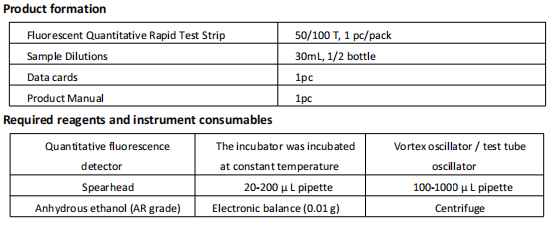
Preparation of sample extraction solution
(1) 50% ethanol water extract: accurately measure 500 mL pure water, then add 500 mL anhydrous ethanol (AR
grade), mix well, seal and store at room temperature
(2) 70% ethanol water extract: accurately weigh 300mL pure water, then add 700 mL anhydrous ethanol (AR
grade), mix well, seal and store at room temperature.
Note: ① laboratories without water production conditions can be purchased to use Wahaha pure water; ②
prepared volume can be proportional amplification
Preparation before testing
1.Please read the operating instructions carefully before starting the experiment. Allow the test card, sample
extract, and sample diluent to equilibrate to room temperature (25 °C) for at least 30 minutes before use
2. Turn on the constant-temperature incubator for the test card and allow it to reach 37 °C before use.
3.Turn on the detector and allow it to preheat for 10 minutes. Insert the ID card for this batch and select the
corresponding calibration curve
Preparation before testing
1. Sample preparation
(1) Grain feed and other solids:
Take the sample to be tested 300-500 g, crushed to more than 90% of the particles can pass the 20-mesh screen.
(2) Vegetable oil Samples:
Take more than 20 g of representative crude oil, centrifuge for 5000 r/min for 2 min, and take a secondary sample
of the upper liquid after centrifugation (vegetable oil other than crude oil is directly weighed without
centrifugation).
2. Sample treatment
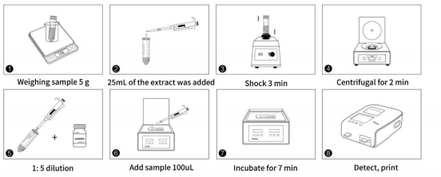
(1) Accurately weigh the 5.0g ± 0.01g sample and place it in a 50 mL centrifuge tube.
(2) Add 25 mL of sample extract and mix with vortex for 3 min. Centrifuge at 5000 rpm for 2 min at room
temperature.
(3) Transfer 100 μL of supernatant into a new centrifuge tube, add 500 μL of sample diluent, and mix well (vortex
for 7 seconds or shake by hand for 1 minute). The mixture is used as the test sample.
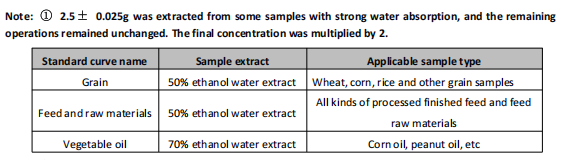
Detection steps
1.Remove the test card from the aluminum foil bag and place it horizontally in the constant-temperature incubator.
Use the test card within 10 minutes after opening the aluminum foil bag.
2.Using a micropipette, draw 100 μL of the diluted sample solution and add it to the sample well of the test card.
Close the lid and incubate for 7 minutes.
3.Insert the data card into the corresponding slot of the detector. On the detector screen, click the “Quick
Detection” button to enter the detection program. Then select the standard curve corresponding to the sample
being tested.
4.After the incubation, immediately insert the end of the detection card facing forward (handheld end facing
outward) into the detector, and click the "Quick Detection" button on the screen for detection (please strictly
control the reaction time for 7min).
5.Read/print test results from the detector
Result output
1.The test results will be displayed on the detector screen, and you can press the print button to obtain the paper
test report, or by exporting the computer;
2. Invalid: The test result may be invalid due to an expired test card, improper operation, or other factors. Please
identify the cause and repeat the test.
3. When the test result exceeds the maximum value of the calibration curve range and further dilution is required.
Take the feed sample as an example, take 1 mL of the supernatant after centrifugation into the centrifuge tube
and dilute it with 50% ethanol solution (for 5-fold dilution: Take 100 μ L centrifuged supernatant into the
centrifuge tube +400μL sample extract, mix it well for use), mix it well, then take 100uL mixture + 500uL diluent
and mix it before testing, and multiply the result read by the instrument by the corresponding dilution factor.
Matters need attention
1.Test cards should be used within the validity period. Test cards, ID cards and diluents of different batches and
different items should not be mixed;
2.After completion of the experiment, the test results can be viewed in the “History Record” section of the
detector interface.
3.Please follow the operation steps and do not touch the strip scanning area during the operation.
4.Please pay attention to the consistency of the experimental operation. Centrigation immediately after the
vortex oscillation. After the centrifugation, remove the supernatant immediately to avoid the extraction effect
over time.
5.Do not place the detector or incubator directly under an air-conditioning outlet.
6.This strip is a disposable product, do not reuse it.
7.After 7 min of incubation, please conduct the test immediately (complete all test cards within 2 min after
incubation);
8.This method is only used for primary screening. In case of positive samples, please use the confirmation method
for confirmation.
9. For any problems encountered during the experiment, please contact the supplier.
Storage conditions and shelf-life
Storage Conditions: For long-term storage, the test card should be kept at 2~8 °C. For recent use, it can be stored
in a cool, dark and dry place at 18~ 25 °C.
Shelf Life: Refer to the outer packaging for the expiration date.
No comments yet. 登录后发起新讨论 发起新讨论