Pribolab - EKT-110-48TPriboFast®β-鹅膏毒肽(β-AMA)ELISA检测试剂盒-95501
PriboFast®β-Amanitin ELISA Kit
| Product: | PriboFast®β-Amanitin ELISA Kit |
| Product Number: | EKT-110-48T |
| Lot: | .Z2F00F25 |
| Manufacture Date: | 2026-07-31 |
| Expiry Date: | 2027-07-30 |
| Storage Conditions: | 2-8℃ |
General Description
There are numerous types of poisonous mushrooms in China, with 435 species recorded. In recent years, there
have been frequent poisoning incidents in China due to accidental ingestion of toxic mushrooms. Over 90% of
these deaths were caused by mushrooms of the genus Amanita. The lethal toxin of Amanita is amatoxin.
According to their amino acid composition and structure, they can be classified into three types: Amatoxins,
Phallotoxins, and Virotoxins, all of which belong to macrocyclic polypeptides. At present, 22 kinds of natural
amanita toxins have been isolated and identified, among which there are 9 kinds of amatoxins, which belong to
bicyclic octapeptides. α-amatoxin and β-amatoxin are the main toxins causing death.This kit is a highly sensitive
and rapid detection product that can quickly and quantitatively detect amatoxin in urine, serum, and mushrooms.
Test Principle
This kit employs a direct competitive ELISA method. Amatoxin antigen is pre-coated on the microplate wells. The
amatoxin in the sample competes with this antigen for the amatoxin enzyme-labeled antibody. After color
development with the substrate solution, the absorbance value of the sample is negatively correlated with the
amount of amatoxin it contains. Compared with the standard curve and then multiplied by the corresponding
dilution factor, The content of amatoxin in the sample can then be determined.
Parameters
LOD (Limit of Detection): Urine: 0.4 ppb; Serum: 0.5 ppb;Fresh mushrooms:1ppb;Dried mushrooms: 10ppb.
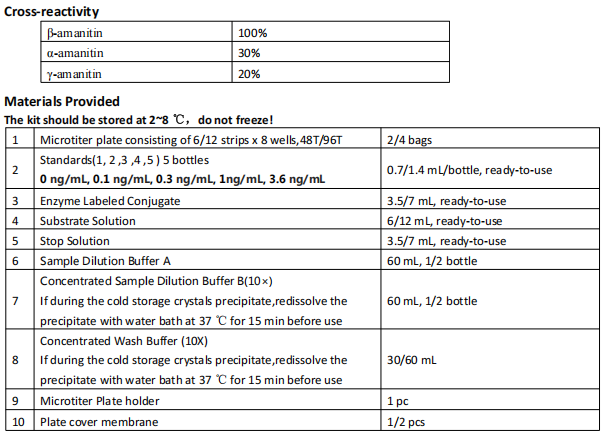
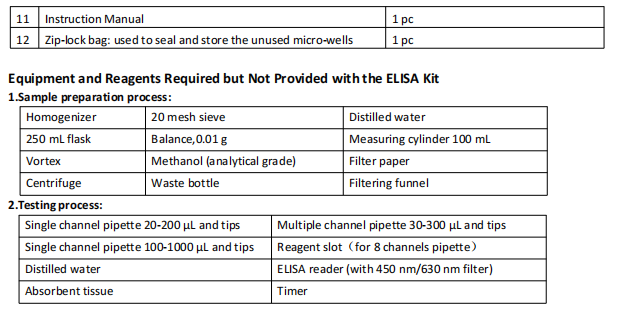
Reagent Preparation
1. Wash buffer working solution: dilute the concentrated wash buffer (10×) to 1× with distilled water
(Concentrated wash buffer : water = 1: 9).
2. Sample diluent buffer B(1X) : dilute the concentrated sample dilution buffer B (10×) to 1× with distilled water
(concentrated sample dilution buffer B: water = 1: 9).
3. 40 % methanol-water solution : dilute the methanol with distilled water at a volume ratio 2 : 3 (methanol:
water = 2: 3).
Precautions
1. Recovery the reagents and strips to room temperature (20~25 ℃) before use.
2. After use, immediately store the reagent at 2–8 °C.
3. The reproducibility of ELISA analysis largely depends on the consistency of the washing step. Proper execution
of the washing procedure is a critical factor in the ELISA process.
4. Cover the micro-wells with plate cover membrane in each constant temperature incubation step, to avoid
exposure the reaction system to a direct sunlight.
Sample Preparation Procedures
Urine (dilution ratio:4)
1. 4 times dilution of the sample: In 1.5mL centrifuge tubes, add 600 µL of sample dilution A and 200 µL of urine
respectively, and mix thoroughly.
2. The well-mixed solution is the solution to be tested.
Serum (dilution ratio:5)
1. 5 times dilution of the sample: In 1.5mL centrifuge tubes, add 400 µL of sample dilution A and 100 µL of serum
respectively, and mix thoroughly.
2. The well-mixed solution is the solution to be tested.
Fresh mushrooms (dilution ratio:10)
1. Crush the sample, weigh 1.0g of the sample and add it to 10mL of sample dilution solution B, then shake and
mix for 5 minutes.
2. Centrifuge the sample at 5000 rpm for 10 minutes. If the supernatant is not completely separated from the
precipitate, the rotational speed or centrifugation time can be appropriately increased. If necessary, the
suspension can be filtered.
3. The supernatant is the solution to be tested.
Dried mushrooms (dilution ratio:100)
1. Crush the sample, weigh 0.5g of the sample and add it to 5mL of 40% methanol/water solution, then shake
and mix for 5 minutes.
2. Centrifuge the sample at 5000 rpm for 10 minutes. If the supernatant is not completely separated from the
precipitate, the rotational speed or centrifugation time can be appropriately increased. If necessary, the
suspension can be filtered.
3. Dilute the supernatant 10 times with sample diluent B, mix well, and it is the solution to be tested.
If the test result of the sample exceeds the determination range of the kit, the sample solution needs to be
further diluted with sample diluent B. The additional dilution factor must be taken into account when calculating
the concentration.
Assay Procedure
1. Prepare samples as described above.
2. Pipette 50 µL of standards or prepared sample solutions into the appropriate microplate wells in duplicate.
3. Add 50 µL of enzyme-labeled conjugate to each well. Cover the plate with a plate sealing membrane and
incubate for 20 minutes at room temperature
4. Wash the plate for three or four times as follows: remove the plate cover membrane,discard the contents of
the wells (dump or aspirate). Pipette 300 µL of pre-diluted washing solution into each well. After the third
repetition empty the wells again and remove the residual liquid by striking the plate against a paper towel. The
wash procedure is critical. Insufficient washing will result in poor precision and falsely positive result.
5. Add 100 µL of substrate solution to each well. Cover the plate with the sealing membrane. Incubate the plate in
the dark at room temperature (e.g., in an incubator) for 10 minutes, as the chromogen is light-sensitive.
6. Stop reaction by adding 100 µL of stop solution into each well. The blue colour will turn yellow upon addition.
7. Gently shake the plate to mix thoroughly. Measure the optical density (OD) of each well at 450 nm (reference
wavelength 630 nm) using an ELISA reader. The color is stable for 10 minutes.
Results Analysis
1. Process the sample as procedures above, the dilution ratio should be accounted for in calculation. Additional
dilution induced due to high sample concentration has to be accounted for in calculation too.
2. Note: Pribolab has a specific data processing software, if necessary, please request through the official email:
Cautions
Please strictly abide by the laboratory regulations to ensure the reliability of the experimental results.
1. All reagents should be returned to room temperature (20~25 °C) before the experiment begins.
2. All reagents should be gently shaken upside down or swirled before use to avoid foaming.
3. Once the experiment has begun, all subsequent steps should be completed consecutively within the
recommended time.
4. Cap all reagents as soon as they are used, and do not exchange caps between different reagents.
5. Use a separate disposable tip for each sample to avoid cross-contamination.
6. The sample and the standard product should be operated at the same time to ensure the consistency of the
experimental conditions
7. Do not mix reagents from different batches.
8. Do not use expired kits.
9. Calibration of precision and accuracy of laboratory equipment and instruments prior to use (micropipette,
enzymograph, etc.).
10. The standard provided in this kit is only intended for the preparation of the standard curve and should not be
used for other purposes.
Health and safety instructions
1. Do not smoke, eat, drink, or pipette by mouth in the laboratory.
2. Wear disposable gloves when handling specimens.
3. Avoid contact of the substrate and stop solution with skin and mucous membranes (possible irritation, burns, or
toxic hazards). In case of contact, rinse the affected area thoroughly with plenty of water.
4. The handling and disposal of chemical products must be carried out in accordance with Good Laboratory
Practice (GLP) guideline
Storage and guarantee period
The kit should be stored at 2~8 ℃.
Guarantee period: See outer packing for the shelflife.
Pribolab Biotech Co.,Ltd.
China Office: Building 21, MAX Business Hongwan, High-tech Zone, Qingdao
Website: www.pribolab.com
No comments yet. 登录后发起新讨论 发起新讨论