Pribolab - EKT-GM060-96TPriboFast®CP4 EPSPS转基因酶联免疫检测试剂盒 PriboFast®CP4 EPSPS ELISA Kit-39918
PriboFast®CP4 EPSPS ELISA Kit
| Product: | PriboFast®CP4 EPSPS ELISA Kit |
| Product Number: | EKT-GM060-96T |
| Lot: | BFJGBC06 |
| Manufacture Date: | 2026-08-04 |
| Expiry Date: | 2027-08-03 |
| Storage Conditions: | 2-8℃ |
General Description
CP4 EPSPS is a herbicide-resistant protein commonly used in crop breeding. Crops transformed with this gene can significantly increase nitrogen metabolism, counteracting the effects of glyphosate herbicides on crops while selectively controlling weeds. This kit uses the double-antibody sandwich ELISA method, which can qualitatively and quantitatively detect CP4 EPSPS protein in samples. Compared with instrumental analytical techniques, the kit is fast, simple, sensitive, and high-throughput, greatly reducing errors and labor intensity.
PriboFast® CP4 EPSPS ELISA Kit is a high-sensitivity detection system, especially suitable for the quantitative detection of leaves, seeds, and bulk grains.
Test Principle
This kit employs a double-antibody sandwich ELISA method to detect CP4 EPSPS protein in samples. The microplate wells are precoated with monoclonal antibodies specific for CP4 EPSPS. When a sample containing CP4 EPSPS is added, the precoated CP4 EPSPS antibodies capture the target protein, forming an antibody–antigen complex (Ag-Ab). Subsequently, an enzyme-labeled antibody (Ab-HRP) is added to bind to this antigen-antibody complex, ultimately forming an antibody-antigen–enzyme-labeled antibody complex (Ab-Ag-Ab-HRP). Following this step, the TMB substrate reagent is used to catalyze a colorimetric reaction, which is then stopped, and the absorbance value is measured using an enzyme-linked immunosorbent reader. The absorbance value of the sample positively correlates with its CP4 EPSPS content; by comparing the measured absorbance value with the standard curve, the concentration of CP4 EPSPS in the sample can be calculated.
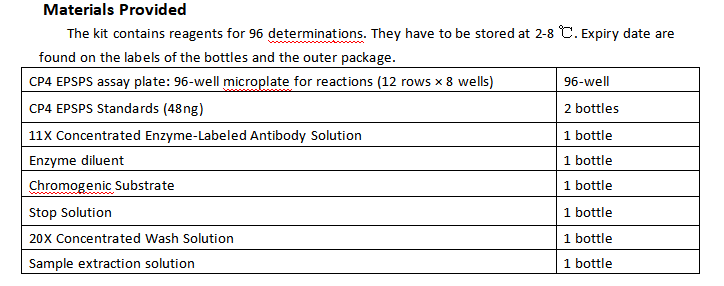
Equipment and Reagents Required but Not Provided with the Test Kit
Microplate reader (450 nm), incubator, shaker, vortex mixer, centrifuge, polystyrene centrifuge tubes (1.5 mL), micropipettes: single-channel (20 μL–200 μL, 100 μL–1000 μL) or multi-channel (300 μL); fresh ultrapure water or deionized water.
Reagent Preparation
● Wash Buffer Solution
Dilute Concentrated wash buffer (20×) with DI water at a ratio of 1:19 to make wash buffer (20×concentrated wash buffer : water = 1 : 19) for use in ELISA plate washing, this washing buffer can be stored at 4 °C for up to 1 month.
● Standard solutions
- Dissolve CP4 EPSPS standards with 1mL of Sample extraction solution, the concentration of this solution is 48 ppb;
- Add 300 μL of the 48 ppb standard to 300 μL of sample extraction solution, resulting in a final solution concentration of 24 ppb;
- Add 300 μL of the 24 ppb standard to 300 μL of sample extraction solution, resulting in a final solution concentration of 12 ppb;
- Add 300 μL of the 12 ppb standard to 300 μL of sample extraction solution, resulting in a final solution concentration of 6 ppb;
- Add 300 μL of the 6 ppb standard to 300 μL of sample extraction solution, resulting in a final solution concentration of 3 ppb.
After dilution of the standard solution, store it away from light at –20 °C for a storage period of 14 days.
● Concentrated enzyme-labeled solution
Use an enzyme dilution buffer to dilute the 11X concentrated enzyme-labeled solution at a 1:10 volume ratio (1 part 11X concentrated enzyme-labeled solution + 10 parts enzyme dilution buffer); for example, 180 μL of 11X concentrated enzyme-labeled solution + 1.8 mL of enzyme dilution buffer can be used for 16-well assays.
Sample Preparation Procedures
Precautions for Sample Processing:
When handling any samples, the following points must be observed:
- Disposable pipettes must be used throughout the experiment;
- The pipette should be replaced when transferring different reagents;
- Prior to beginning the experiment, all laboratory equipment must be inspected for cleanliness, and only clean equipment may be used to avoid contamination that could interfere with the experimental results;
- Leaf samples that cannot be analyzed immediately after collection should be stored at-20°C for no longer than 1 week;
- Collected seed samples should be stored in a cool, dry environment for no longer than 6 months;
- The sample dilution factor is 10.
Sample Preparation of leaves
1. Take 0.05 g sample, put it into a 1.5 mL centrifuge tube and mash it (Note: Use different utensils for grinding to prevent cross-contamination);
2. Add 0.5 mL of Sample Extraction Buffer , vortex for 5 min;
3. Centrifuge at 4000 rpm for 3 min;
4. Use the supernatant as the test solution for next test procedure.
Sample Preparation of seeds
1. Take 0.1 g of crushed seed sample into a 1.5 mL centrifuge tube;
2. Add 1 mL of Sample Extraction Buffer , vortex for 5 min;
3. Centrifuge at 4000 rpm for 3 min;
4. Take the supernatant as the test solution for next test procedure.
Sample Preparation of bulk grains
1. Take 15 g of crushed bulk grain sample;
2. Transfer to an appropriate container, add 75 mL of pure water, and shake thoroughly for 5 minutes.
3. Centrifuge at 4000 rpm for 3 min;
4. Transfer 250 µL the supernatant into 250 µL sample extraction solution, vortex several times.
5. Take 100 μL of the mixed solution for analysis.
Operating Steps
Notice: In any case, prepare ready-to-use standards must be replicated during assay. Once the amount of sample is determined, the standard must be added before and after adding sample test solutions. In the final calculation, average the results. In reference to GLP and QC requirements, sample repetition is necessary for good laboratory practice.
1. Prepare test solutions as described above.
2. Add 100 µL of standard solutions or the sample test solutions into the wells of the test strips. We recommend using duplicates. Incubate for 45 minutes at 25℃.
3. Decant the contents of the wells into a sink. Blot the inverted plate on paper towels. Wash the plate using the diluted wash buffer (300 µL/well) and then decant the wash buffer. Repeat the above process to wash 4 times. Slap the plate on a paper towel to remove as much water as possible. The washing process is critical; insufficient washing can result in poor accuracy and falsely elevated absorbance.
4. Add 100 µL of enzyme labelled antibody to each well and incubate for 30 minutes at 25℃.
5. Repeat the washing step (step 3) to wash the plate 4 times.
6. Add 100 µL of Chromogenic Substrate to each well.
7. Incubate in the dark at 25 °C for 15 minutes.
8. Add 100 µL stop solution to each well, the color of the solution will change from blue to yellow.
9. Read the absorbance at 450 nm (630nm as a reference wavelength) using a microplate reader. The color will stabilize within 5 minutes.
Result Determination
There are two methods for result determination: the first method can be used for rough determination, while the second method is suitable for precise determination; multiplying the calculated value by the sample dilution factor yields the concentration of CP4 EPSPS in the sample. Note that the absorbance value of the sample is positively correlated with the amount of CP4 EPSPS it contains.
- The detection range (ppb) can be determined by comparing the average absorbance value of the sample with the standard values. For example, the absorbance value of Sample 1 is 0.658, and the absorbance value of Sample 2 is 1.358; the absorbance values for the standards are as follows: 6 ppb = 0.3272,12 ppb = 0.5723,24 ppb = 0.8647, and 48 ppb = 1.6162. Thus, the detection range for Sample 1 is 12–24 ppb, and the detection range for Sample 2 is 24–48 ppb.
- Quantitative Analysis:
- Calculation of the absorbance value for the standard: subtract the absorbance value of the sample dilution (background) from the average absorbance value of the standard or the sample (measured in dual-well assays).
- Plotting and calculation of the standard curve: Plot a standard curve with the absorbance values of the standards on the x-axis and the CP4 EPSPS standard concentration (ppb) on the y-axis. Substitute the absorbance values of the samples into the standard curve to read out the corresponding concentration values for each sample. If professional analytical software provided by the kit is used for these calculations, it facilitates accurate and rapid analysis of large numbers of samples.
Cautions
- Recovery all reagents to room temperature (20-25 ℃) before test.
- All reagents should be mixed by gently swirling prior to use. Do not induce foaming.
- Once the assay has been started, all subsequent steps should be completed without interruption and within the recommended time limits.
- All reagents should be capped immediately after use. Caps cannot be exchanged between different reagents.
- Use a disposable pipet tip for each sample to avoid cross contamination.
- All standards and sample test solutions should be run at the same time, so that all conditions of test are the same.
- Do not mix any solutions provided from different lots or do not use expired solutions.
- Check all laboratory equipment in a good condition, such as pipette guns and Microplate ELISA photometer, etc.
- The standard reference materials in this kit are intended solely for constructing the standard curve and shall not be used for any other purposes.
Safety Guidelines
1.Smoking, eating, or using a pipette with your mouth are prohibited in the laboratory.
2.Please wear disposable gloves before the experiment.
3.The skin is prohibited from contacting the Substrate solution and the stop solution (irritation, burns or toxicity hazards may occur). In case of contact, immediately flush the injured area with plenty of water.
4.Please store and handle chemical substances in accordance with GLP standards.
Storage Conditions and Expiry date
Storage Conditions:Store at 2 - 8 ℃.
Expiry date:the expiry date is printed outside of the package.
PRIBOLAB PTE. LTD.
China Office: Building 21, MAX Business Hongwan, High-tech Zone, Qingdao
Official Website: www.pribolab.com
E-mail: office@pribolab.com
Sales: sales@pribolab.com
Technical support: support@pribolab.com
No comments yet. 登录后发起新讨论 发起新讨论